
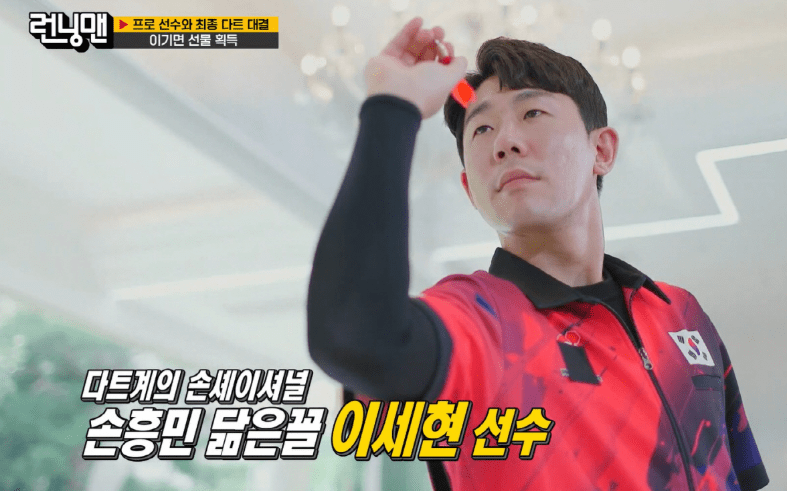
A scene from SBS’s Running Man during a darts challenge. The episode featured professional darts player Lee Se-hyun, whose resemblance to football star Son Heung-min became one of the show’s widely discussed moments. (Image: SBS / Running Man)
A Korean variety show that has been on television for more than a decade is suddenly attracting fresh attention from American search users.
On August 26, Google Trends showed “running man” among rapidly rising searches in the United States, with more than 20,000 searches over the previous 24 hours and search interest rising sharply within hours. The timing is notable. The surge follows a new episode of SBS’s Running Man that generated several highly shareable moments — from a heartfelt tribute to a longtime production crew member to a professional darts player whose resemblance to Korean football star Son Heung-min immediately caught the cast’s attention. But the search spike may reveal something larger than interest in a single episode. It is another example of how Korean entertainment can suddenly re-enter global conversation through a combination of long-running fandom, short-form viral moments, recognizable personalities, and digital discovery.
A Special Episode Built Around 16 Years of Loyalty
The August 23 episode centered on Kang Chan-hee, a camera director who has worked with Running Man since its first episode. The cast participated in a special race designed to prepare gifts for Kang, turning a behind-the-scenes production veteran into the emotional center of the program.
The idea reportedly grew from an earlier comment by host Yoo Jae-suk suggesting that Kang deserved recognition for his years with the show. That history matters. Unlike many entertainment programs built primarily around celebrity guests or short-lived formats, Running Man has developed an identity around long-term relationships — not only among its cast members, but also between the cast and production team. For viewers who have followed the program for years, that continuity creates an unusual sense of familiarity.

Image generated by Google’s generative AI (Gemini) based on the article’s context. This visual is for illustrative purposes and does not depict actual broadcast footage.
A Son Heung-min Lookalike Creates a Viral Moment
Another unexpected moment came when professional darts player Lee Se-hyun appeared during the episode. Members of the cast immediately remarked on his resemblance to football star Son Heung-min. Kim Jong-kook reacted with surprise, while other cast members joined in before Lee recreated Son’s well-known camera celebration. The scene offered exactly the kind of moment that travels easily beyond the original television broadcast. It required little knowledge of the episode’s storyline. Viewers familiar with Son Heung-min could understand the joke almost instantly. That type of cultural crossover is particularly important for international discovery. A Korean television program, a Korean professional athlete with worldwide recognition, humor, and short video clips can intersect within seconds — creating content that can move far beyond the program’s established fan base.
Haha Turns a Failed Mission Into a Personal Gift
The episode also included a more personal moment involving Haha. The cast competed in a darts challenge for gifts intended for Kang, including wild ginseng valued at 500,000 won. After failing to win the prize through the game, Haha ultimately paid for the ginseng himself and gave it to Kang. The gesture transformed what could have been a simple variety-show competition into a scene emphasizing the relationships built over the program’s 16-year history. It also reinforced one of Running Man’s most durable strengths: viewers are not simply watching games. They are watching relationships that have accumulated over hundreds of episodes.
A Hollywood Anecdote Adds Another Global Connection
The same episode included another moment with obvious international appeal. Haha said that he had once received a casting offer connected to The Lord of the Rings and joked with the cast about being considered for a hobbit role. According to the SBS report, he said he ultimately turned down the opportunity because of his Running Man schedule. Whether viewed as a humorous anecdote or a glimpse into the international opportunities surrounding Korean entertainers, the story gave the episode another globally recognizable reference point. For international audiences unfamiliar with every member of Running Man, a reference to a globally known film franchise can become another gateway into the show.
Why Running Man Still Travels Globally
The more interesting question is not simply why one episode became searchable. It is why Running Man can still generate international curiosity after so many years. Part of the answer may lie in the structure of Korean variety television itself. Unlike scripted dramas, individual moments from variety programs can often be consumed independently. A reaction, game, celebrity appearance, joke, unexpected resemblance, or emotional exchange can become a self-contained piece of content. That makes programs like Running Man unusually compatible with YouTube, social media, short-form video, fan communities, and algorithm-driven discovery. A viewer does not necessarily need to watch hundreds of previous episodes before enjoying a 30-second moment. But once that moment captures attention, the program already has an enormous archive waiting behind it.
What the Search Spike Says About K-Culture
The latest U.S. search surge is therefore worth watching beyond Running Man itself. Global interest in Korean culture is no longer driven by a single channel.K-pop, Korean dramas, films, food, beauty, sports figures, online creators, and variety entertainment increasingly overlap in the same digital ecosystem. A football reference can drive interest toward a television program. A television clip can introduce viewers to a Korean celebrity. A celebrity can then lead audiences toward music, food, travel, or other Korean content. Search behavior increasingly reflects these connections. For publishers, creators, and entertainment companies, the important lesson may be that international expansion does not always begin with a large marketing campaign. Sometimes it begins with one highly shareable moment.
The Bigger Picture
Running Man has survived multiple changes in cast, television viewing habits, and the global media environment. Yet the latest U.S. search spike suggests that longevity can become an advantage in the age of digital discovery. The show has something new entertainment properties cannot immediately replicate: years of relationships, thousands of memorable moments, recognizable characters, and an international audience capable of reigniting attention when the right moment appears. The question now is not simply whether Running Man can remain popular. It is how long-running Korean entertainment properties can continue finding entirely new audiences through search, social media, and global digital culture. And this week, at least, American search behavior suggests that Running Man still knows how to run.
CWON Press | K-Culture
Independent insights into the trends shaping global culture and entertainment.
![[Part 2/2] The Scar After Birth: Can siRNA and Low-Dose RNA Delivery Redefine Hypertrophic Scar Treatment?](https://cwonpress.com/wp-content/uploads/2026/08/scar2_lem-s401.cwon-press.png?w=1024)
![[Part 1/2] The Scar After Birth: As C-Sections Rise Worldwide, Hypertrophic Scars Emerge as an Overlooked Women’s Health Issue](https://cwonpress.com/wp-content/uploads/2026/08/scar_lem-s401.cwon-press.png?w=1024)
![[Part 2/2] Who Owns a Cheerleader’s Star Power? KBO Faces a New Debate Over Pay, Exclusivity and Taiwan](https://cwonpress.com/wp-content/uploads/2026/08/cheer-leader2_cwon-press.png?w=1024)
