
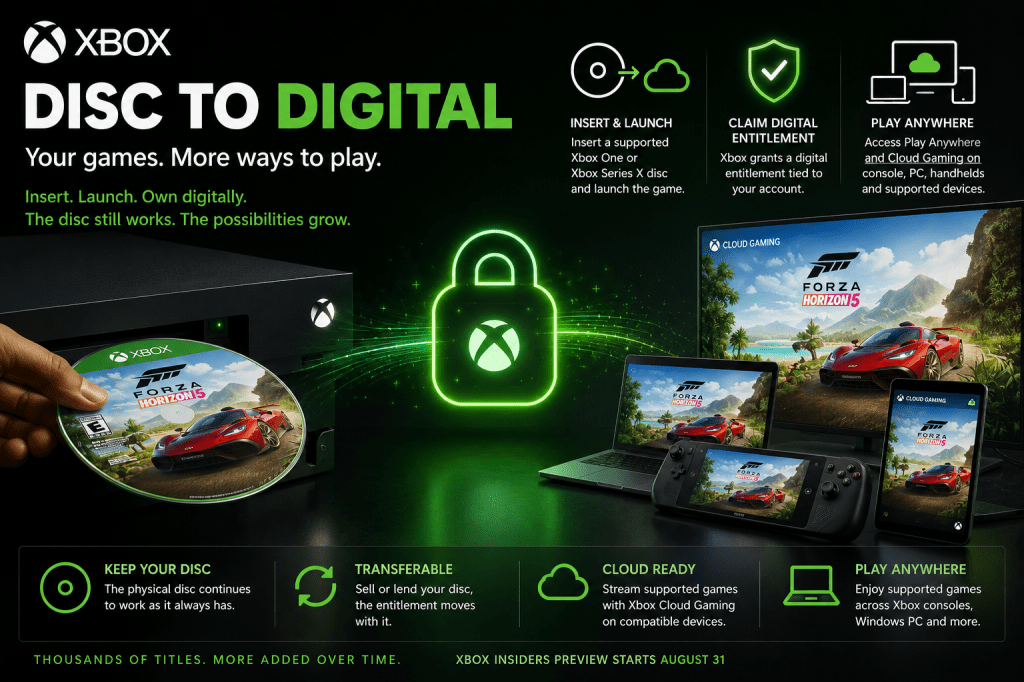
The image illustrates Xbox’s new disc-to-digital feature, showing how supported physical game discs can unlock digital entitlements for Xbox Play Anywhere and cloud gaming while preserving the disc’s continued use and transferability. This image was generated using generative AI with ChatGPT.
Microsoft will let players claim digital entitlements from thousands of supported Xbox discs, unlocking Play Anywhere and cloud benefits while preserving the physical disc — a major attempt to bridge gaming’s physical past with an increasingly digital future.
Microsoft is introducing one of the most unusual answers yet to a question confronting the video-game industry: What happens to decades of physical game collections as consoles move toward a digital-first future? On Aug. 26, Xbox announced a new disc-to-digital feature that will allow owners of supported Xbox One and Xbox Series X game discs to claim a digital entitlement simply by inserting the disc into a compatible console and launching the game. Xbox Insiders will begin testing the feature on Aug. 31, with Microsoft saying it will initially support thousands of titles and expand the catalog over time. The idea sounds simple, but its implications are much larger. A physical Xbox disc will effectively become a key that can unlock many of the benefits normally associated with a digital purchase — potentially including play across Windows PCs, handheld devices and cloud streaming — without destroying or permanently deactivating the original disc. And unlike a conventional trade-in program, Microsoft says the physical disc will continue to function exactly as it did before. That makes the feature less a conversion from physical to digital than a new licensing bridge between the two worlds.
How Xbox Disc-to-Digital Works
The process Microsoft has described is intentionally straightforward. A player inserts a supported Xbox One or Xbox Series X disc into an Xbox console with a disc drive and launches the game. Xbox then recognizes the physical copy and grants a corresponding digital entitlement. Once that entitlement has been created, supported games can gain access to digital Xbox features such as Xbox Play Anywhere and Xbox Cloud Gaming. Microsoft has not announced a separate conversion fee. For a compatible Xbox Play Anywhere title, that could mean a game originally purchased on disc for a console becomes accessible through the same Xbox ecosystem on a Windows PC or supported handheld. For games available through Xbox Cloud Gaming, eligible players may also be able to stream the title to supported devices rather than playing only from the original console.
This is an important distinction. Microsoft is not simply allowing users to install the contents of a disc and then discard it. The company is creating a digital entitlement recognized by the Xbox account and services infrastructure. That could make a shelf of older physical games considerably more useful in a gaming environment increasingly built around cloud services and multiple devices.
The Physical Disc Still Matters
Perhaps the most interesting part of the system is what happens to the disc after the digital entitlement has been claimed. Microsoft says the disc continues to work normally. But reporting by The Verge, which revealed details of the system before Microsoft’s formal announcement, indicates that the digital entitlement is also associated with the specific physical disc used to create it. That means the feature is not designed to give a player two permanently independent copies of the same game. If the physical disc is loaned or sold and another account uses it to claim the entitlement, the digital entitlement can move with the disc. Earlier reporting on Microsoft’s internal testing indicated that the original user would lose that digital entitlement when ownership of the disc effectively changes.
That design could prove crucial to the program’s reception. A system that permanently converted a used disc into a nontransferable digital license could have undermined the secondhand market. Instead, tying the entitlement to the disc creates the possibility of maintaining a familiar principle of physical ownership: Sell the disc, and the right associated with that disc can move to the next owner. If Microsoft’s final implementation works consistently this way, it would preserve more of the lending and resale flexibility that physical-game collectors value.
It Is Not the Same as Receiving a Free Permanent Digital Copy
The distinction may initially confuse players. A digital entitlement can behave similarly to a digital purchase while it belongs to an account, but it remains connected to the underlying physical disc. That makes Xbox’s system fundamentally different from simply inserting a disc once and receiving an independent digital copy forever. The design appears intended to prevent one physical copy from generating multiple permanent digital licenses while still allowing its owner to gain digital convenience.
This creates an interesting hybrid model: physical media establishes ownership; Xbox’s network extends where that ownership can be used.
For consumers, the result could offer much of the convenience of digital distribution without immediately eliminating the economic flexibility of discs. For Microsoft and publishers, meanwhile, it preserves control over duplication.
Thousands of Games — But Not Everything
Microsoft says most Xbox One and Xbox Series X disc-based games will support the feature and that the initial rollout will cover thousands of titles. Not every game will be included from day one. According to The Verge, publishers are expected to have control over whether their games participate, meaning compatibility may differ by title and publisher. Earlier internal-testing information also suggested that some older Xbox One discs might lack the manufacturing information required for the system to identify them properly.
Microsoft’s official announcement specifically covers Xbox One and Xbox Series X disc-based games. It has not announced comparable disc conversion for original Xbox or Xbox 360 physical discs through this program. Earlier reporting indicated those older discs are not supported by the current system, although Microsoft is separately working to bring more games from earlier Xbox generations into its modern ecosystem. So disc-to-digital should not yet be interpreted as a universal solution for every physical Xbox game ever released.
Why Microsoft Is Doing This Now
The timing is important. Microsoft is developing its next-generation Xbox platform, known as Project Helix, as part of a broader strategy that increasingly blurs the boundaries between Xbox consoles and Windows PCs. At the Game Developers Conference earlier this year, Xbox said Project Helix is being designed to play both Xbox console and PC games and emphasized its goal of keeping games from four generations of Xbox playable for years to come. Microsoft plans to ship alpha versions of the new hardware to developers beginning in 2027. Xbox Play Anywhere is another component of that strategy. Microsoft says the program now covers more than 1,500 games, allowing compatible purchases and progress to move between Xbox and Windows devices. Disc-to-digital brings an important missing group into that vision: people who bought games physically. For years, a player with a large disc library could participate only partially in Microsoft’s cross-device strategy. An Xbox disc sitting on a shelf could not easily follow its owner onto a Windows gaming handheld or cloud-connected screen. The new entitlement system attempts to solve that problem. In that sense, disc-to-digital is not merely a backward-compatibility feature. It is infrastructure for Microsoft’s future Xbox ecosystem.
Does This Mean the Next Xbox Will Drop the Disc Drive?
Microsoft has not announced that. That distinction is important. The Verge previously reported that Microsoft had not fully finalized whether Project Helix would ship with an integrated disc drive. The new disc-to-digital program could become especially useful if future Xbox hardware becomes increasingly disc-free, but Microsoft’s official announcement does not say the feature marks the end of physical Xbox games. Still, the direction of the broader gaming market is difficult to ignore. Digital distribution already dominates much of modern gaming, subscription services have become more important, and cloud and handheld gaming are pushing players toward libraries that can follow them across hardware. Microsoft’s challenge is therefore not simply deciding whether discs survive. It is figuring out how decades of physical purchases can remain valuable if the hardware that reads them becomes less central. Disc-to-digital provides one answer.
The Contrast With PlayStation Is Striking
The announcement arrives less than two months after Sony made a much more definitive move away from physical gaming. Sony Interactive Entertainment announced in July that it will end production of physical discs for all new PlayStation games beginning in January 2028. Games released before the cutoff are unaffected, but new titles launching afterward will be offered only in digital form. Sony said the change reflects consumer behavior, arguing that digital media has become the preferred way most players access games. The announcement nevertheless intensified a long-running debate among gamers about ownership, resale, preservation and dependence on digital storefronts. Microsoft has not promised that physical Xbox games will continue indefinitely.
But its strategy currently sends a different message: If the industry is going digital, existing physical libraries should have a pathway into that future.
That distinction could become an important competitive advantage among players who have spent hundreds or thousands of dollars building physical collections.
Game Preservation — but With a Digital Dependency
Microsoft describes the initiative as part of its commitment to game preservation. There is a strong argument for that interpretation. A disc that gains cloud, PC or future-device access can remain useful even when the original console generation becomes obsolete. But the program also highlights the limits of digital preservation. The entitlement depends on Microsoft’s infrastructure recognizing the disc, participating publishers making their titles eligible and Xbox services continuing to support the associated license. That is not the same as possessing a completely independent, archival copy that can function indefinitely without a platform provider. Disc-to-digital therefore improves accessibility and continuity, but it does not eliminate the underlying debate over digital ownership. It changes the balance.
What This Could Mean for Used Games
The secondhand game market may be one of the most important tests. Physical media traditionally provides three economic advantages that digital stores struggle to reproduce: players can lend games, sell them and buy them secondhand. Digital licenses are normally tied permanently to an account and cannot easily be transferred. Xbox’s new model potentially combines the two. Because the entitlement is reportedly linked to the physical disc, the game can remain transferable even after its owner has enjoyed digital benefits. That could preserve the relevance of used-game retailers and collectors even as actual gameplay becomes increasingly digital. It could also make physical games more attractive to some consumers. A buyer could potentially purchase a disc not because they intend to keep inserting it every time they play, but because it gives them both a transferable physical asset and access to digital features. That would be a notable reversal of the conventional assumption that digital convenience inevitably makes physical media less useful.
Xbox Could Make Physical Games More Valuable Just as They Begin to Disappear
There is a paradox at the center of Microsoft’s announcement. The gaming industry is moving away from discs. Yet Xbox may have just made owning a disc more useful. A supported physical purchase can potentially offer: the ability to resell or lend the underlying game, digital access through an Xbox account, compatibility with Xbox Play Anywhere where available, cloud access where supported, and continued operation of the original disc.
A purely digital purchase offers convenience but usually not physical resale. A traditional disc offers resale but historically lacked seamless cross-device access. Xbox is attempting to combine those strengths. Whether the system works smoothly enough to achieve that goal will become clearer once Xbox Insiders begin testing it on Aug. 31.
The Insider Test Will Answer the Biggest Questions
Microsoft still has several practical issues to demonstrate. Players will want to know how quickly entitlements are created, how reliably ownership transfers when discs are sold or loaned, how console sharing behaves, which publishers participate and how unusual editions or multi-disc games are handled. They will also want clarity on the long-term role of the program once Project Helix arrives. The Aug. 31 Insider rollout should provide the first large-scale test of those mechanics. Microsoft says it will continue adding titles over time, while The Verge reports that a broader rollout to Xbox One and Xbox Series X consoles is expected in the coming months. The feature may therefore evolve considerably before it reaches every player.
More Than a Convenience Feature
At first glance, Xbox disc-to-digital sounds like a small quality-of-life improvement. Insert a disc. Get digital access. But it addresses one of the largest unresolved questions in the transition to digital gaming.
What happens to ownership when the medium disappears?
Microsoft’s solution does not fully resolve that debate. The digital entitlement still exists inside a managed platform ecosystem, and participation is not universal. But it offers something players rarely get during a technology transition: a way to bring an old form of ownership into a new distribution model without simply abandoning it. As Sony prepares to stop producing discs for new PlayStation releases in 2028 and Microsoft builds a next-generation Xbox designed around console, PC and cross-device gaming, that bridge could become increasingly important. The future of gaming may still be overwhelmingly digital. Xbox’s new feature suggests that the road to that future does not necessarily require players to leave their physical libraries behind.
![[Part 2/2] The Scar After Birth: Can siRNA and Low-Dose RNA Delivery Redefine Hypertrophic Scar Treatment?](https://cwonpress.com/wp-content/uploads/2026/08/scar2_lem-s401.cwon-press.png?w=1024)
![[Part 1/2] The Scar After Birth: As C-Sections Rise Worldwide, Hypertrophic Scars Emerge as an Overlooked Women’s Health Issue](https://cwonpress.com/wp-content/uploads/2026/08/scar_lem-s401.cwon-press.png?w=1024)
![[Part 2/2] Who Owns a Cheerleader’s Star Power? KBO Faces a New Debate Over Pay, Exclusivity and Taiwan](https://cwonpress.com/wp-content/uploads/2026/08/cheer-leader2_cwon-press.png?w=1024)
