China’s STAR Market and Hong Kong’s Chapter 18A do not eliminate biotech risk — they identify it, disclose it and allow selected investors to price it. South Korea also has a technology-special listing system, yet licensing deals and external validation have increasingly become powerful signals of IPO readiness. The difference may determine which country converts scientific ideas into globally licensable drug assets faster.
For biotechnology startups, one question can determine whether a promising scientific idea ever becomes a drug: Who pays for the evidence before the evidence exists? Drug development is structurally different from most conventional businesses. A biotech company may require hundreds of millions of dollars and many years of research before generating meaningful product revenue. Early clinical failure is common, commercial success is uncertain and a company may remain deeply unprofitable precisely during the period when it is creating the most valuable scientific data. Capital-market design therefore matters enormously. A system that demands extensive commercial validation before granting access to public capital may protect investors from some failures, but it can also produce a circular problem: a company needs clinical data to secure a global pharmaceutical partnership, needs capital to generate the clinical data, yet may struggle to raise that capital unless it already has the partnership.
That dilemma has become increasingly visible in South Korea just as China’s biotechnology industry has emerged as one of the most important sources of new drug assets for global pharmaceutical companies. In 2024, Chinese-origin licensing assets accounted for roughly 31% of innovative pipeline assets in-licensed by major pharmaceutical companies, according to research discussed in Nature Reviews Drug Discovery. Broader DealForma analysis cited by Nature shows the announced value of licensing transactions involving Chinese-origin assets expanding from roughly $5 billion in 2020 to more than $50 billion in 2024 — around 30% of global licensing deal value — while China has grown to account for roughly one-third of global clinical-stage assets.
The momentum continued in 2025. Five of the ten largest R&D licensing partnerships identified by Nature involved China-based companies, and among large pharmaceutical in-licensing transactions carrying at least $50 million upfront, 38% originated from China and represented about 30% of total upfront payments. One of the largest examples was GSK’s agreement with Jiangsu Hengrui Pharmaceuticals, carrying an announced potential value of $12.5 billion and a $500 million upfront payment. This is no longer simply a story about China producing inexpensive generic drugs or copying Western molecules. The Chinese biotech ecosystem has become a major supplier of clinical-stage innovation to multinational pharmaceutical pipelines.
The Korean Paradox: A Technology-Special Listing System That Increasingly Values External Validation
South Korea is not formally closed to loss-making biotechnology companies. KOSDAQ has operated a technology-special listing route since 2005, allowing innovative companies to seek public-market access without satisfying the conventional profitability and revenue requirements applied to ordinary issuers. Under current Korea Exchange rules, technology-growth companies can qualify after assessments by designated specialist institutions, with technological maturity, competitive advantage, R&D infrastructure, target-market potential, commercialization capability and product competitiveness among the factors considered. For the innovation-technology track, the formal framework includes technology assessments at specified grades and significantly relaxed financial requirements compared with ordinary listings.
Crucially, there is no written KRX rule stating that a biotech company must complete a global licensing transaction with a multinational pharmaceutical company before listing. It would therefore be inaccurate to say that KOSDAQ officially lists only companies with technology-transfer deals.
Yet formal rules and real-world incentives are not always the same thing. Korean IPO-market reporting increasingly shows that global licensing agreements, multinational pharmaceutical collaborations and visible clinical milestones provide powerful evidence that a company’s technology has been independently validated. Of ten biotech companies that entered KOSDAQ through technology-special listings in the first half of 2025, many had secured technology-transfer agreements, while Korean financial media have documented a recurring pattern of listing-review withdrawals among pre-revenue drug developers with relatively limited licensing revenue.
That creates a potentially important de facto external-validation premium. From the perspective of an exchange, underwriter or investor, the logic is understandable. Predicting the probability that a preclinical antibody, RNA therapeutic or drug-delivery platform will become a commercial medicine requires specialized scientific, regulatory and clinical judgment. If Pfizer, Lilly, Merck, GSK or another global pharmaceutical company has already committed substantial capital to the asset, that transaction provides an external signal that sophisticated industry experts have examined the technology and found it sufficiently attractive to invest.
But relying too heavily on that proxy can create a structural problem.
The Chicken-and-Egg Problem in Korean Biotech Finance
Imagine a biotech startup possessing a scientifically promising platform and one Phase I asset. To sign a major global licensing transaction, the company may need additional human proof-of-concept data, dose-response information, manufacturing validation or combination-treatment data. Generating those data could require tens of billions of won. Venture investors, however, may hesitate to provide another large private round if they believe KOSDAQ listing prospects are uncertain without a global licensing transaction. The public market may meanwhile view the absence of that transaction as insufficient external validation.
The company is trapped.
No capital without stronger data. No stronger data without capital. No major licensing deal without stronger data. And potentially no attractive IPO path without the licensing deal.
This is the biotech financing Catch-22.
The consequence extends beyond whether individual companies survive. When pre-IPO capital becomes concentrated primarily in companies already perceived as highly likely to list, venture investors rationally redirect money toward enterprises that have already achieved recognizable external milestones. Korea’s own data show this increasing selection effect. Bio/medical venture investment rose 11.2% in 2025 to KRW 1.1889 trillion, its strongest level in several years, yet market observers describe capital as increasingly concentrated in companies with demonstrated achievements rather than being broadly distributed across the development pipeline.
In other words, aggregate investment can recover while early scientific risk capital remains scarce.
This distinction matters enormously.
China Has Chosen a Different Question: Not “Is the Company Safe?” but “Can the Risk Be Identified?”
China’s STAR Market was established in Shanghai in 2019 partly to solve this problem for strategic technology companies. Its differentiated listing standards explicitly allow companies that remain unprofitable or have accumulated losses to enter the public market if they meet specified technology, development and valuation thresholds. The fifth set of STAR Market standards has been particularly important to biotechnology. Under the current framework, an applicant using this route generally requires an expected market capitalization of at least RMB 4 billion, substantial market potential and meaningful development progress; for pharmaceutical companies, at least one core product must have been approved to enter Phase II clinical trials.
This is therefore not an indiscriminate “list first, ask questions later” regime. The threshold remains demanding. Shanghai Stock Exchange data from the earlier operation of the fifth standard showed that roughly 40% of applicants had either withdrawn or been rejected, demonstrating that inclusion does not mean elimination of gatekeeping.
The philosophical difference lies elsewhere.
China has explicitly accepted that unprofitability is a normal state for certain high-quality technology companies and has attempted to separate that risk from fraud, weak technology or poor governance.
In June 2025, the China Securities Regulatory Commission revived the fifth standard for unprofitable technology companies and created a dedicated Sci-Tech Innovation Growth Tier on the STAR Market. Existing and newly listed unprofitable technology companies are placed in this tier, and a visible “U” designation is attached to their stock names. Newly registered Growth Tier companies require investors to sign a dedicated risk-warning agreement before trading. The underlying investor requirement for STAR Market participation remains substantially more restrictive than ordinary retail trading, including RMB 500,000 in qualifying assets and at least two years of investment experience.
The message is fundamentally different from pretending that early-stage biotechnology can somehow be made safe before entering public markets.
It says, in effect:
This company is innovative. This company is still unprofitable. Drug development may fail. Investors should know that explicitly before buying the stock.
China is attempting to manage biotechnology risk through segmentation, disclosure and investor suitability, rather than trying to eliminate the scientific risk before listing.
The “U” Mark Is More Important Than It Looks
The “U” designation may appear to be a small technical detail, but it represents a broader philosophy of capital-market regulation. Investors do not have to infer from hundreds of pages of financial statements that the company carries unusual development risk. The market visibly identifies that risk category. Growth Tier companies are also required to disclose the causes and implications of continued losses, technological-development risks and relevant R&D progress, while sponsors and intermediaries remain subject to ongoing supervision.
The result is a form of risk transfer rather than risk denial. The exchange still determines whether the company meets minimum technological and governance standards, but once those standards are satisfied, the investor is given information and allowed to decide whether the expected return justifies the scientific risk.
That distinction could be particularly well suited to biotechnology, where binary clinical outcomes are impossible for any exchange official to forecast reliably.
China’s Experiment Has Already Produced Measurable Outcomes
The STAR Market’s experience provides useful, although not definitive, evidence that this model can convert public capital into scientific output. According to the Shanghai Stock Exchange, 57 companies had entered the STAR Market while unprofitable by late 2025, and 22 subsequently achieved profitability and removed their “U” designations. Of 22 companies listed under the fifth set of standards, 21 had obtained market approval for a combined 48 self-developed drugs and vaccines, while 16 had subsequently achieved annual revenue above RMB 100 million.
The exchange separately reported that the first 54 unprofitable STAR Market companies collectively invested RMB 163.9 billion in R&D after gaining access to public-market financing. Twenty-two subsequently achieved profitability.
These numbers do not prove that every unprofitable biotech should be listed, nor do they establish causation between IPO financing and eventual drug approval. They do demonstrate something important: a meaningful proportion of companies admitted while still financially immature were able to convert public capital into additional R&D, commercial products and eventually profits.
In October 2025, three additional unprofitable technology companies became the first newly registered issuers admitted to the revamped Growth Tier, including biopharmaceutical companies. The reform therefore moved from policy announcement into actual capital formation.
Hong Kong Adds a Second Capital-Market Engine for Chinese Biotech
Any comparison between China and Korea must also account for Hong Kong. Mainland China’s STAR Market and the Hong Kong Stock Exchange operate under different legal and regulatory systems, so they should not be treated as a single exchange. Economically, however, together they provide Chinese biotechnology companies with multiple public-market financing routes.
Hong Kong introduced Chapter 18A in 2018 specifically to permit clinical-stage, pre-revenue biotech companies to list without satisfying the ordinary Main Board profit tests. A Chapter 18A applicant must generally have at least one Core Product beyond the concept stage, an expected market capitalization of at least HK$1.5 billion, at least two years of operating history under substantially the same management and working capital sufficient to cover at least 125% of costs for the following 12 months.
The exchange does not simply rely on generalist financial review. HKEX maintains a Biotech Advisory Panel that can assist with the scientific and technical aspects of applications, and in May 2025 it launched the Technology Enterprises Channel, or TECH, which includes a dedicated specialist team to engage with prospective biotech applicants even before formal submission.
By the end of January 2026, 84 companies had listed through Chapter 18A, raising more than US$17.5 billion since the regime was introduced. Sixteen biotechnology companies listed in Hong Kong during 2025 alone.
This creates something South Korean biotech companies do not yet possess at comparable scale: multiple specialist public-capital channels explicitly designed around the economics of drug development rather than conventional corporate profitability.
China’s Advantage Is Not Just IPO Policy
It would nevertheless be a serious analytical mistake to attribute China’s biotechnology boom entirely to easier listings. Capital-market reform is only one component of a much larger system.
China possesses an enormous clinical-trial population, large hospital networks, extensive CRO and CDMO infrastructure, deep pools of STEM-trained scientists and a substantial cohort of executives and researchers with previous experience at Western pharmaceutical companies. Nature Reviews Drug Discovery identifies returning talent, government support and China’s established drug-development and manufacturing infrastructure as major factors behind the emergence of Chinese-origin global assets.
The scale of private financing is also dramatically larger. One 2026 industry survey estimated that China’s innovative-drug sector recorded approximately 319 financing events and US$9.2 billion of private financing in 2025, excluding post-IPO rounds. Korea’s official bio/medical VC statistics put comparable domestic new venture investment at approximately KRW 1.19 trillion, or roughly US$830 million. The definitions and databases are not directly comparable, so these numbers should not be interpreted as an exact China-to-Korea multiple, but the difference in capital depth is nevertheless substantial.
China can therefore place many more scientific bets simultaneously. Most will not become globally successful drugs. But biotechnology operates partly through portfolio statistics: if a country finances hundreds of credible programs, moves them rapidly into human testing and terminates weak projects quickly, the probability that some will produce globally attractive clinical data rises sharply.
Why Global Pharma Is Buying Chinese Assets
Global pharmaceutical companies do not license Chinese molecules because they want to support China’s industrial policy. They license them because many Chinese biotech companies increasingly generate the combination that Big Pharma values most: competitive molecules, human data, rapid development and economically attractive deal terms.
The timing is particularly favorable. Global pharmaceutical companies face major patent expirations during the second half of this decade and urgently need replacement pipelines. China has increasingly specialized in producing assets that may be early enough to retain substantial commercial upside but sufficiently advanced to show human pharmacology or proof-of-concept. The 2025 surge in Chinese licensing demonstrates that this development model has become deeply integrated into global pharmaceutical business development.
This also illustrates the self-reinforcing nature of the Chinese system. Capital finances clinical trials. Clinical trials produce data. Data attract multinational partnerships. Partnerships validate companies and return upfront payments to the ecosystem. Investors then recycle capital into the next generation of companies.
The important asset is therefore not merely money.
It is capital velocity.
Korea Risks Creating the Reverse Feedback Loop
South Korea could unintentionally produce the opposite cycle. If a large technology-transfer contract becomes an increasingly important practical signal for IPO success, investors naturally prefer companies that already possess such contracts. Companies without them receive less capital. Less capital means slower clinical development. Slower clinical development means fewer opportunities to generate data attractive to global pharmaceutical partners. Fewer partnerships then reinforce perceptions that those companies are insufficiently validated.
This is how an apparently prudent investor-protection policy can, at the ecosystem level, become innovation rationing.
There is another potential distortion. If a Korean biotech believes that obtaining any recognizable global licensing agreement materially increases IPO probability, management may become incentivized to sign an agreement earlier than economically optimal, accept a smaller upfront payment, grant a broad option or surrender geographic rights primarily to create an “IPO credential.” Such behavior may make a company easier to finance in the short term while transferring disproportionate long-term asset value to the multinational partner.
A capital market should ideally reward a good licensing transaction.
It should not inadvertently create pressure to sign a licensing transaction for the purpose of qualifying for capital.
Does Korea Exchange Lack Biotech Expertise? The Answer Is More Nuanced
A common criticism within the Korean biotech industry is that highly specialized technologies are difficult for general capital-market reviewers to evaluate, encouraging reliance on external signals such as multinational pharmaceutical deals. That concern deserves serious attention, but it would be inaccurate to state simply that KRX has no biotechnology expertise. Korea’s technology-special listing process already uses external designated technology-assessment organizations, including the Korea Health Industry Development Institute and Korea Research Institute of Bioscience and Biotechnology, among others.
More importantly, the Korean government itself appears to recognize the broader expertise problem. In December 2025 the Financial Services Commission announced a KOSDAQ reform strategy explicitly described as creating a more dynamic “easy entry for innovative companies, prompt exit for non-viable companies” structure. The plan calls for approximately 60 specialist technology advisers in strategically important sectors to support KRX’s technology-tailored listing review and improve both expertise and review speed. Interestingly, biotechnology was cited as the sector in which such a tailored review structure already existed, with the government planning to extend the model to AI, aerospace and energy.
This is significant because Korea is, at least conceptually, beginning to move toward the same principle visible in the STAR Market: admit credible innovation more efficiently and strengthen mechanisms for removing companies that later prove non-viable.
The debate is therefore no longer whether Korea recognizes the problem.
The question is whether implementation will change the incentives actually experienced by biotech companies and investors.
KOSDAQ, STAR Market and HKEX 18A: Three Different Ways to Allocate Biotech Risk
| KOSDAQ Technology-Special Listing | Shanghai STAR Market Fifth Standard / Growth Tier | HKEX Chapter 18A | |
|---|---|---|---|
| Profit required at listing | No | No | No |
| Core review philosophy | Technology assessment plus qualitative listing review | High technology threshold plus public-market risk segmentation | Specialist biotech eligibility based on development progress |
| Global licensing deal required | No explicit requirement | No | No |
| Clinical-development benchmark | Considered within technology/commercial assessment; no universal single Phase II rule | Pharmaceutical core product generally must have Phase II trial approval | Core Product must be beyond concept stage; typically Phase I completed with regulatory clearance to progress |
| Distinctive risk mechanism | Disclosure and technology-special listing structure | “U” unprofitable designation + Growth Tier + dedicated risk acknowledgement | Prominent development-failure disclosures and continuing R&D reporting |
| Specialist review support | External specialist technology-assessment institutions; further expert-adviser expansion planned | STAR Market scientific/technology review infrastructure | Dedicated Biotech Advisory Panel and TECH specialist channel |
| Investor access | Ordinary KOSDAQ investor market | STAR Market investor eligibility requirements; additional risk agreement for newly listed unprofitable companies | Main Board investor access, with enhanced biotech disclosure rules |
| Underlying philosophy | Validate sufficiently before broad public access | Accept scientific risk but identify and price it | Accept pre-revenue biotech if development and funding thresholds are satisfied |
The difference is subtle but consequential. Korea asks whether a company has accumulated enough evidence to justify public-market access. Shanghai asks whether the company is technologically strong enough to be admitted despite explicitly recognized financial risk. Hong Kong asks whether a core product has progressed sufficiently beyond scientific concept to justify allowing investors to fund the remaining path toward commercialization.
None is a completely open market.
But they allocate uncertainty differently.
Investor Protection Does Not Necessarily Require Preventing Investors From Taking Risk
This distinction deserves attention because “investor protection” is sometimes implicitly interpreted as preventing retail investors from encountering highly uncertain businesses. Biotechnology makes that nearly impossible. Even a Phase III program can fail. A licensed program can be returned. A multinational partner can change strategy. An approved product can underperform commercially.
A major licensing deal therefore does not eliminate risk.
The Korean market has already seen examples in which licensed assets were subsequently returned for reasons that did not necessarily reflect the original science, demonstrating why technology-transfer history itself can be a double-edged validation metric.
China’s alternative is not to pretend these risks disappear. The Growth Tier identifies unprofitable issuers, requires explicit risk disclosure and limits access through investor-suitability rules while permitting investors who meet those requirements to make their own decisions. Hong Kong requires biotech issuers to prominently warn that their Core Products may ultimately fail to be developed or marketed successfully.
That is an important philosophical shift:
Investor protection can mean preventing inappropriate investment — or it can mean providing enough information for qualified investors to knowingly accept risk.
For high-risk, high-return biotechnology, the second model deserves serious consideration.
What Korea Could Learn Without Copying China
Korea should not simply replicate China’s STAR Market. China has a much larger domestic capital pool, patient population, biotech industry and policy-finance apparatus. Korea also has legitimate reasons to be cautious after several technology-special-listed companies experienced accounting, governance or business-continuity problems.
But the policy choice does not have to be either unrestricted IPO access or an excessively conservative gate.
A more sustainable Korean system could shift the primary question from “Has another global company already validated this technology?” toward “Is the scientific and development risk sufficiently characterized that appropriately informed investors can evaluate it?”
That would mean deeper modality-specific specialist review, explicit segmentation of pre-revenue clinical-stage companies, standardized disclosure of runway and expected financing needs, visible high-risk designations, strengthened sponsor accountability, clearer post-listing clinical-milestone disclosures and faster delisting when governance or business viability deteriorates. Korea’s announced “easy entry, strict exit” policy points in this direction.
The objective should not be to increase the number of biotech IPOs for its own sake.
It should be to determine which risks belong at the exchange gate and which risks should be disclosed and priced by the capital market.
CWON Press Analysis: China Is Financing the Experiment — Korea Risks Financing Only the Result
The most important difference between the two ecosystems can be summarized in one sentence.
China increasingly uses capital to generate validation. Korea risks requiring validation before providing access to capital.
That does not mean every Chinese biotech succeeds or every Korean biotech is underfunded. China itself suspended or tightened the unprofitable-company IPO route for roughly two years before reopening it in 2025, and its fifth-standard listings remain highly selective. Korea, meanwhile, continues to produce globally competitive biotechnology companies and saw bio/medical venture investment recover in 2025.
But ecosystems compete statistically, not anecdotally. If China finances several times more early clinical programs, enables more companies to access public markets before profitability, produces clinical data faster and repeatedly recycles licensing upfront payments into new R&D, it does not need every company to succeed. It needs enough successes to generate another Hengrui, another 3SBio or the next globally competitive therapeutic platform.
Korea’s challenge is different. Its scientific talent is strong, its universities and hospitals are sophisticated and Korean biotechnology has repeatedly demonstrated the ability to produce globally licensable assets. What it lacks is the scale of risk capital available in China and the United States. In that environment, requiring too much external commercial validation before public-market financing can have a disproportionately damaging effect.
The paradox becomes unavoidable:
If only companies that have already proved global commercial interest can obtain the capital necessary to prove global commercial interest, what happens to the technologies that require one more clinical study before the world recognizes their value?
That is where the future competitiveness of K-biotech may ultimately be decided.
China’s recent capital-market reforms suggest one answer: classify the risk, disclose it clearly, restrict participation where appropriate — but allow capital to fund the experiment.
South Korea now appears to be reconsidering its own balance between entry and exit. Whether its new reforms genuinely restore that financing cycle may determine whether the next generation of Korean biotech companies becomes independent global drug developers — or is forced to sell its most promising science before it has accumulated enough data to capture its full value.
Editor’s Note
This article distinguishes formal listing requirements from observed market practices. Neither KOSDAQ’s technology-special listing rules nor China’s STAR Market rules require a global pharmaceutical licensing transaction as a universal condition for listing. References to a “de facto external-validation premium” in Korea represent CWON Press analysis based on recent IPO outcomes, financing patterns and industry reporting rather than an official KRX policy. Comparisons of Chinese and Korean biotechnology financing should also be interpreted cautiously because available datasets use different definitions and reporting methodologies.
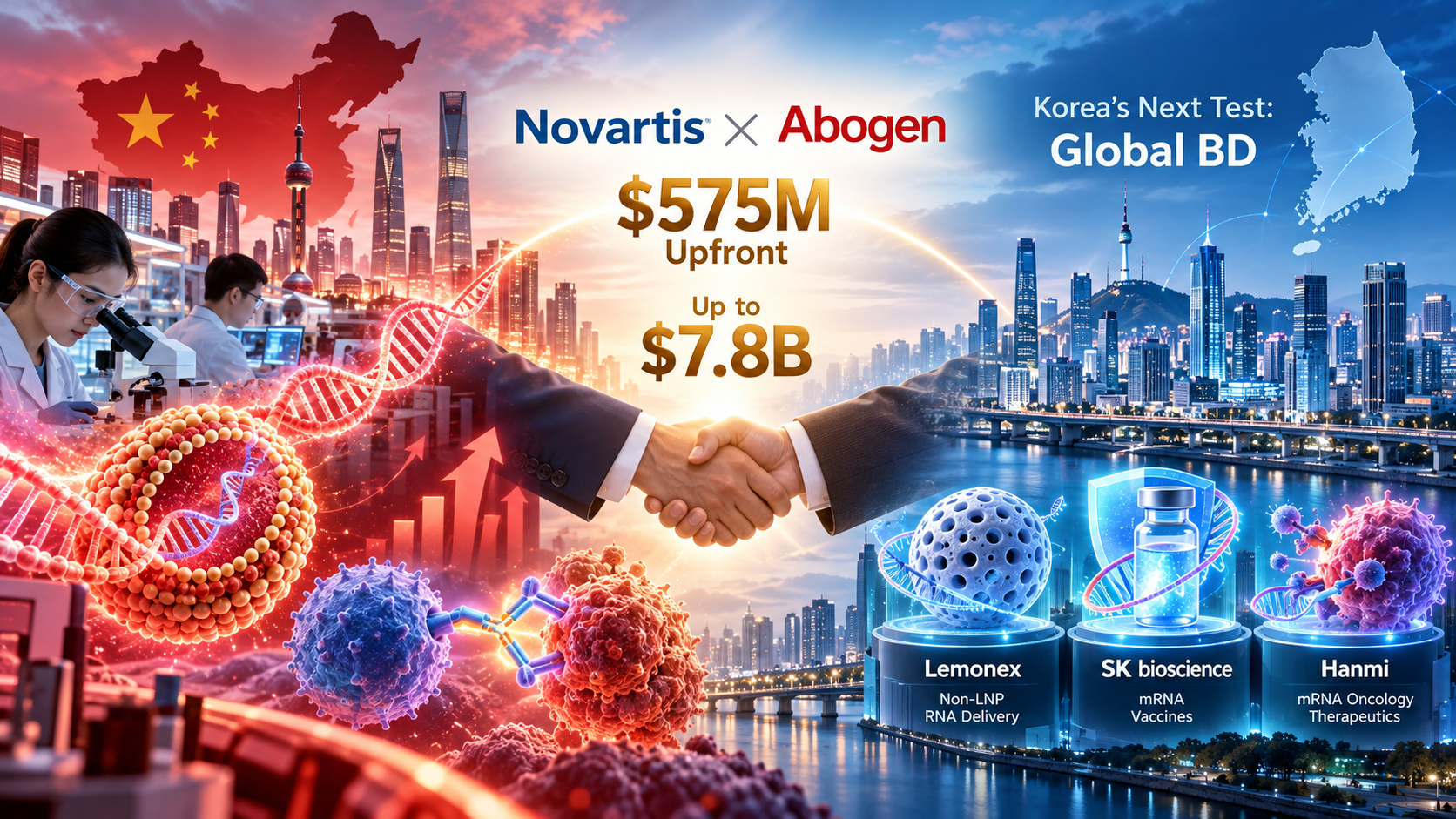
* The lead image at the top of this article illustrates how China and South Korea take different approaches to financing biotech innovation, contrasting China’s STAR Market model of identifying and pricing development risk with Korea’s growing emphasis on technology assessment and external validation for IPO readiness. The lead image was generated using generative AI with ChatGPT.