Moderna shares have risen more than 600% in 2026 after a landmark Phase 3 melanoma result transformed the company’s investment narrative. ESMO 2026 could provide the next major catalyst — but after such a dramatic re-rating, the question is no longer whether intismeran works. It is how well it works, how broadly it can scale, and how much of that future value is already reflected in Moderna’s stock price.
Analysis date: October 13, 2026 | Based on Nasdaq closing price on October 12, 2026
Moderna closed at $213.74 on October 12, down 5.0% for the session after gaining 14.2% on October 9. The stock touched a new 52-week high of $227.46 during Monday’s session and is now up approximately 625% year to date, giving the company a market capitalization of roughly $85.3 billion. That extraordinary rally is difficult to explain as a short-lived speculative trade alone. Moderna is being revalued from a company historically dependent on COVID-19 vaccine revenue toward a potentially broader mRNA therapeutics platform, with oncology now at the center of the investment thesis.
The key catalyst is intismeran autogene, formerly mRNA-4157/V940, Moderna’s individualized neoantigen therapy being jointly developed with Merck. On August 19, Moderna and Merck announced that the Phase 3 INTerpath-001 study met both its primary recurrence-free survival endpoint and a key secondary distant metastasis-free survival endpoint in 1,137 patients with completely resected stage IIB-IV melanoma. The companies described both improvements as statistically significant and clinically meaningful, with no new safety signal observed. The market reaction was spectacular. Moderna shares jumped from $62.96 on August 18 to $174.38 on August 19, a 176.97% single-day gain. Now comes the harder test.
ESMO 2026: Three Presentations, but One Dominant Catalyst
Moderna has three intismeran presentations scheduled at the ESMO Congress 2026 in Madrid, October 23-27. However, they should not be treated as equally important for valuation.
| Presentation | Timing in Korea | What Investors Get | Likely Market Importance |
|---|---|---|---|
| LBA1 – INTerpath-001 Phase 3 melanoma | Oct. 24, 11:30 PM KST | Detailed efficacy and safety results | Very high |
| 3151P – Phase 1 pancreatic cancer | Oct. 25, 8:00 PM KST | Early clinical results with FOLFIRINOX | Moderate |
| 2550TiP – INTerpath-014 NSCLC | Oct. 26, 8:00 PM KST | Phase 3 trial design, not new efficacy data | Low |
Moderna will also hold an investor webcast at 7:00 PM CEST on October 24, corresponding to 2:00 AM KST on October 25. The LBA1 presentation is by far the most important. Investors already know that INTerpath-001 succeeded. What they do not yet know is the precise magnitude of benefit: the hazard ratios, absolute recurrence differences, subgroup consistency, maturity of follow-up and detailed safety profile. That distinction matters enormously after the stock’s 600%-plus rally.
Phase 2b Set a Very High Bar
At ASCO 2026, five-year follow-up from the earlier randomized Phase 2b KEYNOTE-942 study showed that intismeran plus Keytruda reduced the relative risk of recurrence or death by 49%, with an RFS hazard ratio of 0.510. The combination also reduced the relative risk of distant metastasis or death by 59%, with a DMFS hazard ratio of 0.411. Merck.com Those numbers are important benchmarks, but they should not be misread as absolute percentage-point reductions. They are relative risk reductions derived from hazard ratios. If the much larger Phase 3 study reproduces an effect size reasonably close to Phase 2b, the scientific implications would be substantial. It would strengthen the argument that personalized mRNA cancer vaccination is not merely a melanoma product concept, but a potentially scalable immuno-oncology platform. By contrast, Phase 3 can be statistically positive yet still disappoint investors if the magnitude of benefit is materially smaller than Phase 2b. At the current valuation, “positive” may no longer be enough.
The Valuation Problem: Science Has Improved Faster Than Current Earnings
Moderna’s balance sheet remains strong, but its current operating results look very different from its market capitalization. Second-quarter 2026 revenue was $145 million, while net loss was $782 million. Cash, cash equivalents and investments stood at $6.91 billion at June 30, and management projected year-end cash and investments of $4.7 billion to $5.2 billion. Quarterly revenue is seasonally affected by the vaccine business, so Q2 should not be annualized mechanically. Still, the contrast between an approximately $85 billion equity value and current earnings makes one point clear: Moderna’s valuation now depends heavily on future pipeline commercialization. The economics of intismeran also need to be understood correctly. Under the worldwide Merck collaboration, development costs and eventual profits or losses are generally shared equally. Moderna therefore does not retain 100% of the economics of future intismeran sales. That means melanoma alone may not be enough to justify a sustained valuation well above current levels. Long-term upside increasingly depends on intismeran expanding successfully into additional tumor types such as lung, bladder and renal-cell cancers, alongside contributions from Moderna’s broader vaccine and therapeutic portfolio. Wall Street disagreement reflects this uncertainty. Citi recently downgraded Moderna to Sell with an $80 target after the stock’s extraordinary rally, arguing that oncology expectations embedded in the valuation had become aggressive. William Blair, by contrast, upgraded Moderna to Outperform after the Phase 3 melanoma success, viewing the result as a major improvement in the company’s path toward revenue diversification.
The Bigger Question: Is Moderna Becoming an Oncology Platform Company?
One positive development outside cancer is the FDA’s August 5 approval of MFLUSIVA, Moderna’s mRNA seasonal influenza vaccine for adults aged 50 and older. That broadens the company’s commercial portfolio and demonstrates that Moderna continues to convert mRNA programs into approved products. Yet oncology is now the component capable of producing a much larger strategic re-rating. The ESMO data will therefore be judged on two levels. Clinicians will ask whether adding intismeran meaningfully improves outcomes for resected melanoma patients. Investors will ask whether the result provides enough confidence to assign meaningful probability-adjusted value to the rest of the INTerpath program. That second question may ultimately matter more to Moderna’s share price.
Bottom Line
Moderna’s scientific position has improved dramatically in 2026. The first positive Phase 3 readout for an individualized neoantigen therapy represents a landmark event for mRNA oncology, and intismeran has moved from an experimental technology story toward a credible potential commercial product. But the stock has moved even faster. At $213.74 and approximately $85 billion in market capitalization, the next leg higher requires more than confirmation that Phase 3 was technically successful. Investors will want evidence that the clinical benefit is large, durable and broadly reproducible — and that personalized mRNA oncology can eventually support multiple commercially meaningful indications. For that reason, October 24 may be less about whether Moderna’s cancer vaccine works and more about how much success the current valuation has already priced in.
Investment & Editorial Disclaimer
This article is provided solely for informational, journalistic and analytical purposes. It includes analysis and estimates derived from publicly available information, including Moderna and Merck press releases, regulatory filings, scientific-conference schedules, published market data and third-party research. Some statements regarding future clinical outcomes, regulatory approvals, commercialization potential, valuation and possible share-price ranges are forward-looking analytical estimates and may differ materially from actual outcomes.
Nothing in this article constitutes an offer, solicitation, recommendation or inducement to buy, sell or hold Moderna securities or any other financial instrument. CWON Press does not guarantee the accuracy of future scenarios or investment outcomes. Equity investments, particularly biotechnology stocks around major clinical events, can involve substantial volatility and the risk of partial or total loss of principal. Investors should make decisions based on their own judgment, financial circumstances and independent research, and should consider consulting a qualified financial professional where appropriate.
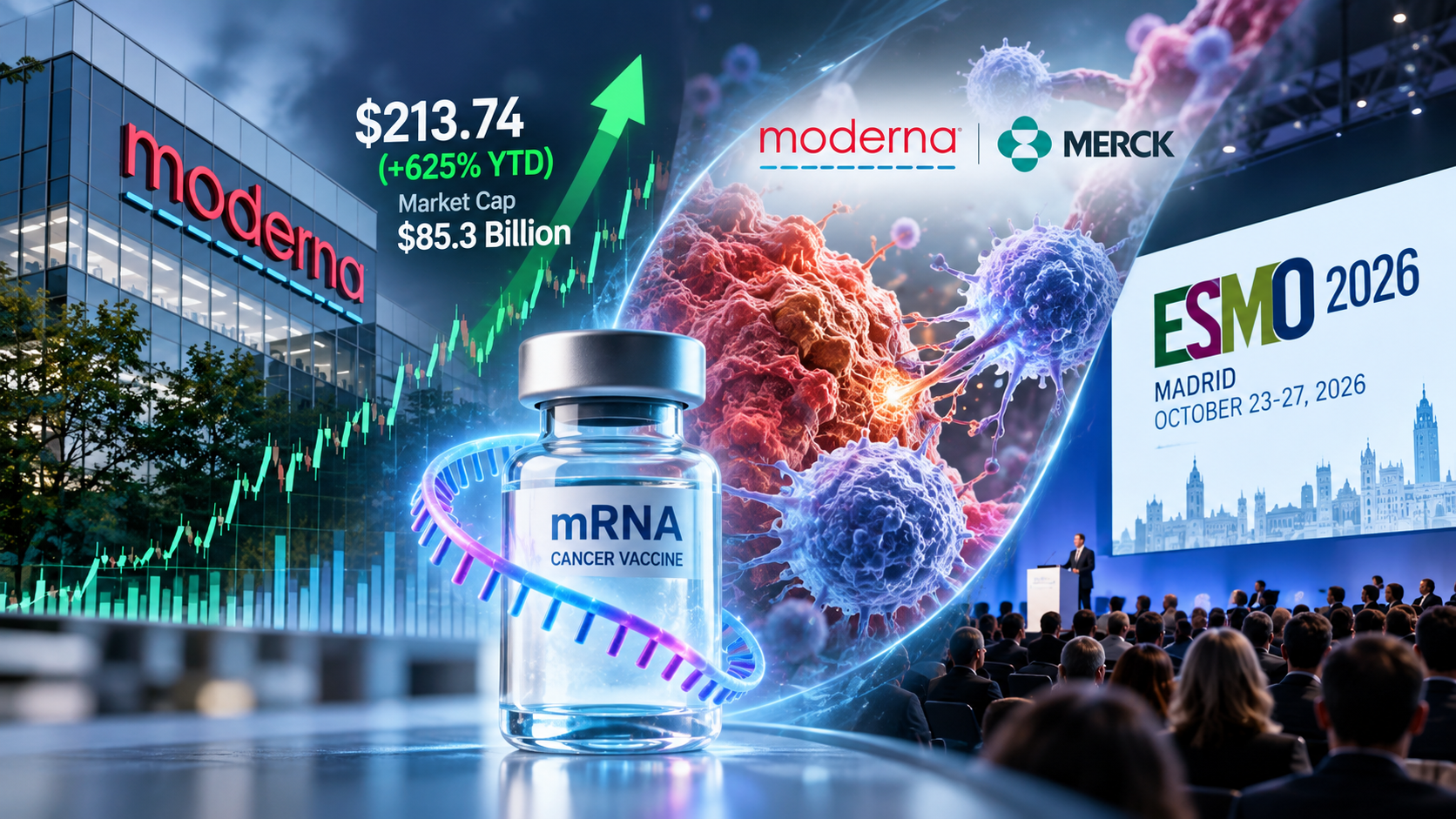
This lead image illustrates the convergence of biotechnology, oncology and capital markets surrounding Moderna ahead of ESMO 2026. It highlights the company’s dramatic 2026 stock re-rating, the Phase 3 success of intismeran autogene — Moderna and Merck’s individualized mRNA cancer vaccine — and the importance of detailed ESMO melanoma data in determining whether Moderna’s approximately $85 billion valuation can be supported by a broader oncology platform. This image was generated using generative AI with ChatGPT.